

 The Link
Over the past 40 years, researchers and professionals in human services and animal welfare have established significant Links between animal abuse, child abuse and neglect, domestic violence, elder abuse and other forms of violence. Mistreating animals is no longer seen as an isolated incident that can be ignored: it is often an indicator or predictor crime and a “red flag” warning sign that other family members in the household may not be safe. If we protect pets, we also protect people — and vice versa.
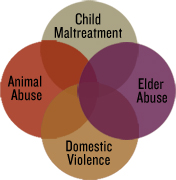
We call these inter-species connections of violence The Link. The National Link Coalition is a nonprofit, multi-disciplinary, collaborative initiative to increase awareness and address public policy, programs and research. We serve as the Global Resource Center on The Link between Animal Abuse and Human Violence. We want to stop the cycle of violence that often affects multiple family members. To achieve this critical goal, we need your help.
Read more about The Link.
Visit our online library to learn even more.
WHAT IS THE NATIONAL LINK COALITION?
The National Link Coalition is the only international educational and advocacy organization working to prevent animal cruelty, domestic violence, child maltreatment, and elder abuse by showing how they intersect. As the international resource center on The Link between animal cruelty and human violence we train multi-disciplinary professionals, showcase programs, and publicize legislation and research to foster collaborations that create safer communities by recognizing that when animals are abused, people are at risk, and when people are abused, animals are at risk.
MISSION STATEMENT
The Mission of the National Link Coalition is to promote and maintain the only international resource center addressing the Link between animal cruelty and human violence in order to provide access to these resources worldwide.
VISION STATEMENT
It is understood that there is a Link between violence against humans and violence against animals. Through the global recognition and integration of this understanding into policies and practices, all people and animals will be measurably safer.

Thank you for supporting the National Link Coalition.
Click here to see what donors like you have helped the National Link Coalition to accomplish since 2008.
And click here to make your tax-deductible contribution.
You can help keep our programs going and – more important – keep people, animals, families, and communities safer from animal cruelty, domestic violence, child maltreatment, and elder abuse.Through our combined efforts, we have made gigantic strides in The LINK between animal abuse and human violence. Let’s keep our progress going and growing!

CONTACT US
To join the National Link Coalition (it’s free!), to find a speaker to address your organization or to receive our free monthly e-newsletter about Link activities, please contact:
National Link Coalition
c/o Phil Arkow, President/Secretary
16 Grasshopper Drive
Etowah, NC 28729
856-816-8559
arkowpets@snip.net
Visit us on Facebook 
 and LinkedIn
Thank You to our generous supporters!
The National Link Coalition is a nonprofit organization, incorporated in the State of North Carolina and is declared exempt under Section 501 (c) (3) of the Internal Revenue Code. Donations to the National Link Coalition are deductible to the fullest extent allowed by law. Copies of our incorporation and tax exemption documents are available upon request.